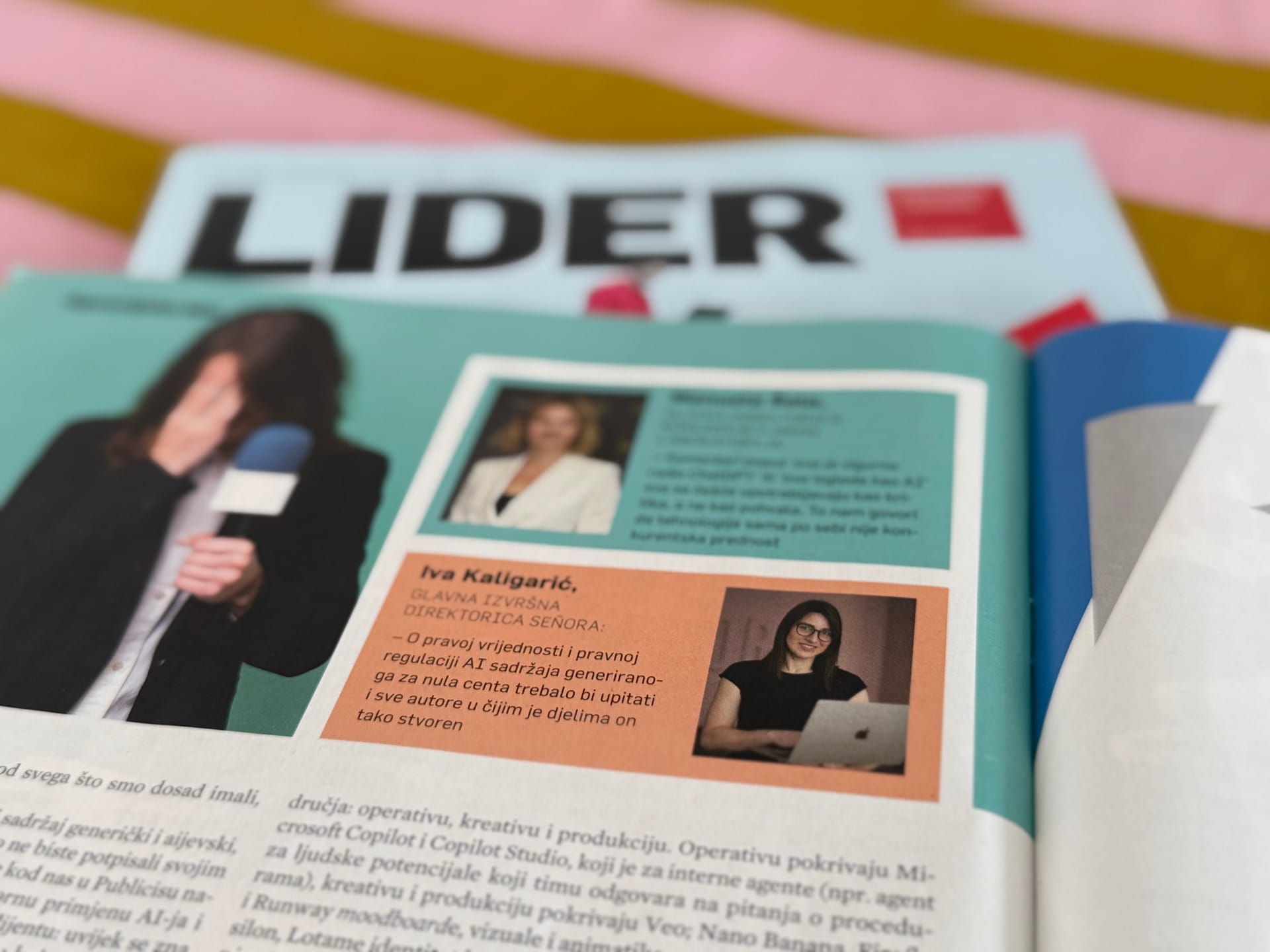
When it comes to AI in marketing, everyone is crossing swords, and our Iva has joined the fray with her pen for Lider's Agencijsko bilo. Are AI campaigns killing creativity, what are the implications of the slop era, and does the future hold artificial perfection or humanity with all its flaws? Find out in this short and sweet interview.
Is there a limit of good taste, responsibility, and even legal consequences when it comes to using content and campaigns partially or entirely created by AI?
At Señor, we prefer campaigns generated by our own intelligence. We explore and test AI tools to assist with research and setting tasks, but what we offer is authorship that we create and sign, and in it we see our advantage and our purpose. We can guarantee that we created it, which makes regulating the rights simple. To clients purchasing AI generated content, I suggest contracting the work as transparently and in as much detail as possible, making sure that all rights to the created content are regulated and paid for. It is also worth looking into the origins of not just the content, but the tools used to create it. A lot about generative AI is still in a legal grey area, so clients have to decide for themselves whether they want to take that risk. As for the true value and legal status of AI content generated for zero cents, we should also ask the Authors whose copyrighted works these models were trained on.
What is your stance on the use of AI in marketing agencies?
My opinion is that technology should not be seen as the enemy, because it cannot fully replace meaning, emotion, and human experience. I believe AI does not kill creativity, it steals work from average creatives. And why would we aim for average? Average already exists. We are here to create new value, to change worn-out patterns that are no longer sustainable, to express ourselves and strengthen the purpose of the individual. But how do we create when the very purpose of creatives is threatened by the pressure of AI? Collective anxiety naturally pulls us toward the comfort zone, which happens to be AI's natural habitat. It has settled into a proven space with no big risks, where you feel safe and comfortable. This space is bounded by the knowledge we have collectively handed over to it. If we nestle in there, we will be fine in the short term, but in the long term we will not resolve the anxiety. There is also no real progress in that zone. That is why it is important to step out and create, to develop our creative faculties, while at the same time exploring technology that can free us from work we find boring and repetitive and speed up the realization of our ideas. The good news is that we are slowly but surely leaving the world of manufactured perfection behind. The future lies in expressing individuality, in a world where imperfection is welcome, where the artificially polished gives way to craft, and originality keeps gaining value.